
Tolkien and Race
Yes, we have to talk about orcs

In Junot Díaz's brilliant novel, The Brief Wondrous Life of Oscar Wao, the title character is a precocious and unpopular boy growing up in New Jersey, who wants to be the "Dominican Tolkien." Those of us of who were introverted and bookish teenagers may see a lot of ourselves in Oscar. There is, however, this heartbreaking moment to consider:
He read The Lord of the Rings for what I'm estimating the millionth time, one of his greatest loves and greatest comforts since he'd first discovered it, back when he was nine and lost and lonely and his favorite librarian had said, Here, try this, and with one suggestion changed his life. Got through almost the whole trilogy, but then the line "and out of Far Harad black men like half-trolls" and he had to stop, his head and heart hurting too much. (307)
For the reader who loves Tolkien and has grown to love Oscar through the course of the book, this is a punch in the gut. We must acknowledge this enormous, gaping blind spot in Tolkien’s work—his apparent racializing of evil throughout his greatest book. We may well say that Tolkien was a man of his time, and we would be right, but he was also a deep and visionary thinker, who may have come to recognize some problems with his construction of race in Middle-earth. However, he never seemed to acknowledge the extent to which he marks the orcs as "other," along with the Haradrim, through recognizably racial characteristics. As twenty-first-century readers, it is important for us to contextualize this apparent blind spot, not in order to excuse it, but rather to understand it.
Ideologies of Race
One of the most egregious results of the romantic nationalism of the nineteenth century was the consolidation of racial ideology as a means to justify imperialism, exploitation, and enslavement. Well into the twentieth century, language suggesting ideologies of racial hierarchy was quite common in the popular press, which demonstrates its pervasiveness. Accounts by British newspapers of the sinking of the Titanic, for example, were full of praise for the calm and noble behavior of English passengers and casually indicated that this reflected the nobility of the "Anglo-Saxon" race.1 Victorian interest in "purity of blood" is apparent even in their invention of dog shows for "pure breeds."2
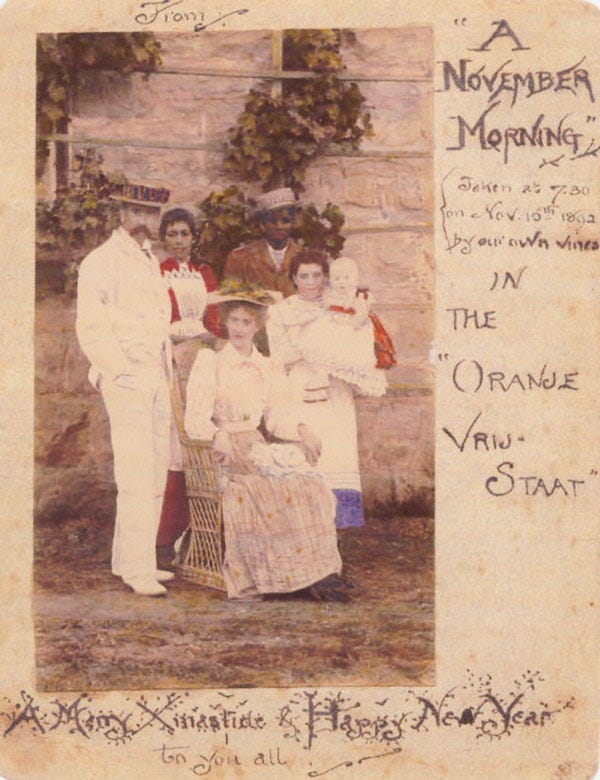
Tolkien was born into this imperial world in 1892 in the Orange Free State, which would become South Africa. An early colorized photograph from a postcard (see above) shows an infant Tolkien with his parents and three women, who appear to be domestic servants, one of whom is clearly a woman of color. I do not know enough about late Victorian family photographs to guess whether this shows a particular regard for the servants, or if this was simply common practice.
In any case, Tolkien's mother brought him and his younger brother to England three years later, and they never returned to Africa, his father having died shortly after they left. There are few traces of this early biography in his letters, but there is one letter to his son Christopher, stationed with the RAF in South Africa during the War, which may be relevant. Christopher had apparently mentioned the poor treatment of black people where he was stationed, and Tolkien replies: "The treatment of colour nearly always horrifies anyone going out from Britain, and not only in South Africa. Unfortunately not many retain that generous sentiment for long" (107).
His meaning here is not entirely clear, but it seems to suggest the idea that immersion in a racist society is likely to make someone racist in order to maintain privilege. His response to another sort of racism in another context is much more to the point. In 1938, a German publisher that was undertaking a translation of The Hobbit wrote to him to inquire about his origins and whether or not they were "Aryan." His response is hilariously pedantic but also firm in its ethics:
I regret that I am not clear as to what you intend by arisch. I am not of Aryan extraction: that is Indo-iranian; as far as I am aware none of my ancestors spoke Hindustani, Persian, Gypsy, or any related dialects. But if I am to understand that you are enquiring whether I am of Jewish origin, I can only reply that I regret that I appear to have no ancestors of that gifted people. (48)
He goes on to object to the nature of the inquiry. Needless to say, the publisher cut ties, and no German translation would appear until 1957. Note that he focuses on language rather than race, and this seems typical of his thinking. In another, much later letter (from 1967) he objects to the use of the term Nordic because of its association "with racialist theories" (528). Once again, he prefers linguistic terms as more accurate and useful.
Beyond these hints, it is hard to discern his more general feelings or ideas about race beyond his objection to outright racism and racist ideology. As an academic in the very white, male bubble of Oxford in the mid-twentieth century, it is unlikely that he was called upon to consider the issue in much depth—which may be why his construction of race in his books seems "under-theorized" in some ways.
The Great Chain of Being
The construction of race in his books may also have to do with his use of the medieval concept of the "Great Chain of Being," a hierarchy of "things" in the universe, decreed by God, which placed God and the angels at the top, then the saints, then humans, animals, plants, rocks, etc. Since Tolkien includes other beings besides humans who use language, it gets tricky. Are elves above humans? Perhaps. What about dwarves, hobbits, and ents? Where do they stand in relation to each other? And then what about orcs or, more problematic still, half-orcs?
There does seem to be a racial hierarchy implied when it comes to humans as well: Aragorn is exceptional largely because he has the "blood of Númenor," and, therefore, has a much longer lifespan than most people. He is the rightful king simply because of his ancestry, going back to Isildur. (Lucky for us that he seems more worthy of kingship than was Isildur.)
Perhaps more significant than these general ideas, however, is how the text sometimes uses recognizably racial characteristics to mark some as "other." It is, after all, a moment of racial marking that crushes Oscar in Junot Díaz's novel.
This is a complex issue. After all, to the hobbits, especially early in the text, everyone who is not a hobbit is strange. But by the time we reach the Council of Elrond, it becomes clear that despite the differences between humans, hobbits, elves, and dwarves, they will be able to work together in a common cause. This is underscored by the subsequent friendships between Legolas and Gimli, and between the hobbits and Treebeard.
There are some, however, who are excluded from this multicultural alliance: orcs and men from the south.
The Uruk-Hai
We will hold off on the men of the south for a couple of weeks, since we have not really encountered them yet in our reading, but we get our first really close look at orcs this week with the Uruk-Hai and their forced march with Merry and Pippin across the fields of Rohan, and it is not pretty. They are brutal, quarrelsome, cruel, sadistic, and hideously ugly and foul-smelling. Their language is full of insult and mockery, and it sometimes suggests a negative version of military culture with talk of “orders” and rank: “a grim dark band, four score at least of large, swart, slant-eyed Orcs” (451).
In addition to the racial descriptors, the orcs also refer to the men of Rohan by their skin color and seem to have some notion of what we might call “white” culture. Consider this bizarre exchange, as they are being pursued by a band of the Rohirrim:
“But what are we going to do at sunrise?” said some of the Northerners.
“Go on running,” said Uglúk. “What do you think? Sit on the grass and wait for the Whiteskins to join the picnic?” (449)
This is strange indeed: how would an orc know about picnics—a European bourgeois pastime if there ever was one? According to the OED, a “picnic” is a modern concept, and the word was not in regular use until the nineteenth century. What do we make of this?
One possible response is that these are Saruman’s orcs in particular, and are, therefore, more adjacent to human concerns. However, when we meet the orcs of Mordor later, we will see that they employ vocabulary that similarly suggests a knowledge of human culture. (The strangest orc conversation of all takes place near the end of The Two Towers, and we will discuss that in a couple of weeks.)
Concerning Saruman’s orcs, there is also the suggestion that they are actually half human. Treebeard speculates later about what Saruman is up to: “I wonder what he has done? Are they men he has ruined, or has he blended the races of Orcs and Men? That would be a black evil!” (473).
Tolkien, of course, was under no obligation to include this idea of racial blending, and it seems a misstep, even in his own time. But since he has done so, this begs the question: how do orcs reproduce? Are there female orcs and baby orcs and orc families? And how would Saruman go about “blending the races”? There is no contemplation of these questions in the text. Orcs are a problem, an infestation to be eradicated like so many termites. (Note the game that Gimli and Legolas play at Helm’s Deep, when they keep score of how many orcs that they have killed.)
In the film of The Fellowship of the Ring, Peter Jackson offers up a kind of theory concerning the creation of orcs, as we see them emerge from large, tended vats of slime, as if from a genetic laboratory from Hell.
The Corruption of Orcs
So this seems to leave us with a lot of questions and no good answers, though I have a theory—one which does not excuse Tolkien from unthinkingly using racial markers, but that perhaps explains the place of orcs in his universe: for Tolkien, they are not a racial construction in a modern sense (though they may invoke some semblance of such ideology), but rather they are a part of a moral typology.
This is suggested in another letter that Tolkien wrote to Christopher in 1944 (ten years before the publication of The Fellowship of the Ring, though the content demonstrates that the concept of the book was mostly fully formed by that point). Christopher had apparently complained of the brutally bad behavior of many of his military comrades during his service in the Second World War. Tolkien writes:
For we are attempting to conquer Sauron with the Ring. And we shall (it seems) succeed. But the penalty is, as you will know, to breed new Saurons, and slowly turn Men and Elves into Orcs. Not that in real life things are as clear cut as in a story, and we started out with a great many Orcs on our side. . . . . Well, there you are: a hobbit amongst the Uruk-Hai. (113)
For Tolkien, it seems that exposure to brutality and the exercise of power over others is potentially corrupting, that it brings out whatever sadism or cruelty is lying dormant in a person. When that cruelty emerges, they become orcs—figuratively. If this is the case, then those corrupted by power in Tolkien’s universe may manifest this in a physical transformation, as they become twisted and deformed mockeries of men and elves, and this is, once again, a medieval narrative trope. (Think of, for example, the horrific ugliness of Chaucer’s corrupt Summoner—who has a face that frightens children).
This medieval conception of physical deformity as a reflection of one’s moral state sits uneasily with our twenty-first-century values and with our understandings of physical disability. Tolkien lacked such vocabulary. But he did have a strong sense of ethics and justice, though it was sometimes imperfectly expressed. It is unfortunate that he was not as forward-thinking on issues of race as he was concerning ecology, but these shortcomings may help us to understand his work in the context of his time. The same goes for gender—and we will get to that soon.
Thanks for reading, from my fancy internet typewriter to yours.

For examples of such newspaper prose, you might listen to the brilliant historians Tom Holland and Dominic Sandbrook in their recent podcast series on the Titanic. The first episode is here:

For all the faults of the film adaptations, I can’t believe that it wasn’t Tolkien who came up with the line: “Looks like meat’s back on the menu, boys!”