
It’s Been Quite a Party: Journey and Friendship in McMurtry’s West
A guest essay by Matthew Long


Gentle reader:
It has been a great pleasure to watch Matthew Long’s wonderful Substack, Beyond the Bookshelf, grow over the last couple of years. This week, Matthew and I are collaborating: he will be publishing an interview with me, and I am publishing this guest essay, which is entirely in the spirit of Personal Canon Formation. If you have not subscribed to Matthew’s newsletter, then please do so.
Meanwhile, I’m going to find the time to go back and read Lonesome Dove again myself. Enjoy.
Yours,
John
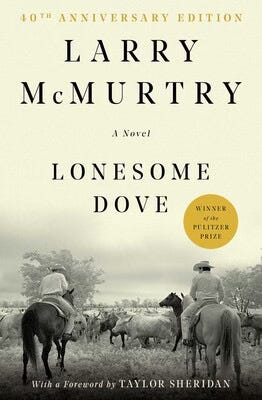
More than thirty years ago, I took my father’s worn paperback copy of Lonesome Dove off the shelf and began to read. I was in high school, navigating the turbulent waters of adolescence while carrying the secret weight of trauma I wasn’t ready to name. My father—one of the last cowboys in this country, a man who had lost a leg like Augustus McCrae—loved Larry McMurtry’s sprawling Western, and I thought understanding the book might help me understand him. Recently, I returned to McMurtry’s work, reading all four books in the Lonesome Dove tetralogy chronologically: Dead Man’s Walk, Comanche Moon, Lonesome Dove, and Streets of Laredo. Between these two readings stretches three decades of life, loss, and the accumulation of experience that changes how we see everything—including the books we thought we knew.
During my years at sea, successful navigation required understanding not just your destination, but your starting position, the currents around you, and what the journey itself revealed. This mindset applies to how I approach literature now. What I discovered in returning to McMurtry wasn’t just a story about two aging Texas Rangers driving cattle to Montana. It is an intense meditation on journey itself—the kinds of movement that transform us and the kinds that merely postpone our reckoning with ourselves. It is also a story about friendship: how two people can be indispensable to each other while remaining fundamentally unable to give each other what they most need. Most importantly, it is a confrontation with the question at the heart of every individual life: what survives the changes time makes in us?
Where I Started
My first encounter with the Lonesome Dove story came through the television miniseries, which I watched with my father. Tommy Lee Jones, Robert Duvall, Danny Glover, Diane Lane, and Anjelica Houston all brought their characters to live. We loved it—the heroism and tragedy, the scope and intimacy, the way it captured something true about the masculine codes and silences that shaped my father’s generation. A few years later, I reached for Dad’s dog-eared paperback, eager to experience the story again while hoping the book’s deeper layers might help me decode the man sitting in the next room.
The timing was significant. I was dealing with all the emotional drama high school entails, but beneath that ordinary turbulence lay something darker: the traumatic abuse I had experienced and couldn’t yet speak about. Reading became a form of escape, a way to inhabit other lives and other struggles while avoiding my own. Lonesome Dove offered exactly what I needed then—a story of men facing hard things, of journeys away from painful pasts, of finding purpose in perpetual motion. I didn’t yet have the language or distance to see how perfectly this mirrored my own strategy of survival: keep moving, don’t speak the unspeakable, define yourself through action rather than acknowledgment.
My father had lost his leg a few years before, an amputation that echoed Gus McCrae’s own loss and subsequent refusal of the same surgery in the novel’s devastating climax. Watching my father navigate the world with that loss, maintaining his dignity and competence despite the limitation, I saw something of Gus’s stubborn insistence on meeting death on his own terms. There was also something of Woodrow Call in him—the stoic silence, the inability to speak feeling, the way duty and competence became substitutes for more vulnerable forms of connection. Reading Lonesome Dove at seventeen, I was trying to understand the code my father lived by, even as I was unknowingly absorbing versions of the same masculine silence that would take me years to unlearn.
Fast forward thirty years. My son, now an adult, had never seen the miniseries, so we watched it together. The experience brought back a flood of memories—not just of the story, but of that earlier shared experience with my father. It reminded me how certain narratives become woven into family history, how stories become inheritance. I had heard about the other books in McMurtry’s tetralogy but never read them. This seemed like the right moment: I was three decades older, with a more refined and disciplined reading practice. McMurtry had died a few years earlier, prompting renewed critical attention to his work. And I was curious to read the complete arc chronologically—to meet Gus and Call as young men and follow them to their deaths, seeing how McMurtry structured their journeys from the vantage point of knowing how they would end.
The conditions for this reading were completely different from my first encounter. I wasn’t fleeing trauma into fiction; I was investigating it, using literature as a lens to understand patterns of masculinity, silence, and motion that had shaped both the characters and my life. I wasn’t trying to decode my father; I was trying to understand the cost and gift of the legacy he gave me. And I was thinking seriously about canon formation—about which books earn a permanent place in our interior lives and why.
Augustus McCrae’s Journey Toward
Augustus McCrae is one of literature’s great studies in how a man can evolve profoundly while remaining essentially himself. What makes Gus’s journey so compelling across the tetralogy is precisely this tension between transformation and constancy—he changes deeply while somehow never betraying his fundamental nature.
The young Gus we meet in Dead Man’s Walk is already charming and talkative, but he’s also deeply romantic in the naive sense. He believes in grand gestures, in the power of wanting something badly enough, in the possibility that love can overcome circumstance. His first disastrous Ranger expedition begins chipping away at this innocence. The brutal realities of frontier violence, the indifference of the landscape, the way good intentions crumble against hard facts—all of this starts teaching him that optimism must become something more durable than mere hopefulness.
By Comanche Moon, we see a Gus who has learned to hold things more lightly, who understands that loss is woven into the fabric of frontier life, yet remains stubbornly committed to beauty, conversation, and love. His relationships with Clara and with the prostitutes he cares for show a man who has accepted that the grandest dreams remain unfulfilled while refusing to let that acceptance harden him into cynicism. He’s developing what will become his defining gift: the ability to be fully present to life as it is, rather than mourning what it isn’t.
What changes most dramatically across the tetralogy is Gus’s relationship with time and limits. The older Gus of Lonesome Dove has achieved philosophical acceptance—a clear-eyed understanding that life is finite and most dreams remain unrealized. Yet paradoxically, this makes him more rather than less vital. He has learned that the substance of life isn’t in achieving goals but in how you pass the days: talking, reading, savoring beauty, maintaining friendship. While others scramble after purpose and accomplishment, Gus has discovered that meaning resides in attention and presence.
Throughout life, Gus maintains his belief that tenderness and attention matter more than toughness. He has a gift for seeing people clearly without judgment, for treating everyone from prostitutes to Comanche warriors with a baseline respect that doesn’t depend on their social position. He refuses to let frontier brutality harden him into something less than fully human. While Call becomes increasingly trapped in duty and competence, Gus remains fluid, capable of joy even in the shadow of death.
The lessons Gus carries to his death are bittersweet. He has learned that love—real love—requires presence, not just grand gestures from a distance. His decades-long pining for Clara was a form of romanticism, a way of having feeling without the complications of actual intimacy. When he finally has the chance to join her after his injury, he recognizes that the fantasy can’t survive the reality of who they’ve both become. His choice to refuse amputation isn’t about giving up; it’s about finally understanding what dignity means to him personally—that some things are worse than death, including becoming less than yourself.
He has learned that talking, which others dismiss as idle, is actually a form of generosity—a way of keeping loneliness at bay for himself and others. His endless philosophizing serves a purpose: it maintains human connection in a world bent on reducing people to functions. And perhaps most poignantly, he has learned that some forms of restlessness are terminal, that men like him and Call are fundamentally unfit for settled happiness even though they long for it. The tragedy of Gus isn’t that he dies too soon, but that he dies having achieved genuine wisdom about how to live while lacking a life where that wisdom can be fully enacted.
Woodrow Call’s Journey Away
If Gus’s arc is about arriving at acceptance and presence, Call’s is about the horror of perpetual flight from the self. Reading the tetralogy chronologically reveals Call’s trajectory as one of the most devastating in American literature—a man who constructs himself so thoroughly around motion and competence that he becomes incapable of inhabiting his own life.
The young Call of Dead Man’s Walk is already driven, already defining himself through capability and endurance. But there’s still possibility in him—he hasn’t yet fully armored himself against vulnerability. He can still be surprised, still be reached. Through Comanche Moon, we watch him systematically close off every avenue to intimacy. He can’t speak his love for Maggie. He can’t claim Newt as his son. He can’t meet Gus in the realm of feeling. Each failure to speak becomes another layer of calcification.
The tragedy is that his silence is an almost constitutional inability to translate internal experience into words. Call literally doesn’t have the language for his own interior life. He experiences feeling but can’t name it, can’t give it form through speech, and therefore can’t acknowledge it even to himself. What he can’t speak doesn’t, for him, fully exist.
By Lonesome Dove, this has become his defining prison. The cattle drive is a perfect metaphor: it’s movement without arrival, purpose without destination. Yes, there’s the stated goal of Montana ranch land, but everyone including Call seems to understand that the real point is the going, not the arriving. He can’t retire to the farm Gus suggests because stopping would mean confronting everything he’s spent his life outrunning—his failures as a father, his emotional isolation, the hollowness at the center of all his competence. He needs the drive to Montana because he needs not to be still.
Streets of Laredo is culmination and exposure. Reading it chronologically, you feel the full weight of what Call has done to himself. He’s now tracking Joey Garza across a West that no longer needs Rangers. The frontier is being tamed by railroads and towns and the very civilization he helped make possible. The historical moment that gave his restlessness meaning has passed. Yet, Call can’t stop moving because stopping would mean facing the void.
Streets of Laredo is brilliant and merciless because McMurtry strips away everything that let Call function. Gus is dead. Newt is dead too. And Call is aging, a ghost haunting a world that’s moved past him. The sections featuring Pea Eye—now married, raising children, fully present to domestic life—show us exactly what Call might have had. They make clear that Call’s inability to settle wasn’t about the frontier or historical timing; it was about a fundamental refusal or inability to engage in the work of self-recognition.
The chronological reading reveals that Gus could name things, could speak himself and others into clarity. Call can only do. And when there’s nothing left worth doing, when the moment that needed his particular competence has passed, he’s left with nothing but the mechanical continuation of movement itself. The horror is that he survives. Unlike Gus, who gets a death consonant with how he lived—surrounded by people, speaking until the end—Call just persists, trudging forward because stopping would mean dissolution.
Streets of Laredo shows us that this kind of unlived life is worse than heroic death. Call ends not with tragic grandeur but with exhausted continuation, still unable to speak, still unable to stop, still unable to arrive at the self he’s been fleeing his entire life. It’s the bleakest ending imaginable precisely because it isn’t an ending—just an old man continuing to move through a landscape that no longer has use for him.
The Friendship as Its Own Journey
Gus and Call’s friendship is the beating heart of the tetralogy, and three moments across the four books capture its essential truth—not its drama, but what it actually means.
The first is the texture of everyday companionship in Lonesome Dove—those porch-sitting scenes before the drive begins. Here the friendship feels most alive, most real. They’re not doing anything momentous; they’re just inhabiting the same space with the ease of decades. Gus needles Call, Call grunts or deflects, and beneath it all is profound comfort. What’s revelatory is that Gus’s talking isn’t really about getting responses—it’s about keeping Call tethered to human experience, about preventing him from disappearing entirely into silence. And Call’s presence, his willingness to sit and endure Gus’s philosophizing, is his wordless version of intimacy. It’s the only place Call ever seems close to peaceful. This is the friendship at rest, showing us that for all their differences, they’ve created a shared life where they don’t have to perform or explain themselves.
The second moment is Gus’s death scene—when the friendship becomes most tragic. What destroys you isn’t just that Gus is dying, but that he spends his final hours trying to get Call to speak, to acknowledge what they’ve been to each other. “It’s been quite a party, ain’t it?” Gus says, trying to frame their decades together, to make Call see it as the gift it was. And Call can’t do it. Even at this extremity, even when Gus is asking him to say something true, Call remains locked in silence. Gus dies knowing that Call loves him but will never be able to say it, will never be able to receive or articulate the gift of their friendship. The tragedy isn’t that they didn’t love each other—it’s that Call’s incapacity means that love remains unspoken and therefore, for Call, somehow unreal.
The third moment is Call carrying Gus’s body across the country on a return trip to Lonesome Dove—when the friendship becomes most true. McMurtry makes us see this as devotion and pathology. Call can tend to Gus’s corpse with meticulous care but couldn’t speak to him when he was alive. He can cross a continent to fulfill Gus’s burial wishes but couldn’t claim his own son. Call’s love for Gus is real and profound, but it’s the love of a man who can only express feeling through action, through duty, through perpetual motion. And Gus, even dead, is still the companion Call talks to in his head—the only person he ever got close to genuine conversation with, even if it was mostly one-sided.
Together, these moments show a friendship built on opposite ends of a spectrum: Gus’s fluency and Call’s silence, Gus’s capacity for presence and Call’s need for motion, Gus’s ability to name things and Call’s imprisonment in the unnamed. This opposition was what made them indispensable to each other—Gus needed someone to anchor his talk, Call needed someone to speak his unspoken life. Their friendship was the closest either man got to being fully known, even though one talked constantly and the other hardly at all.
This dynamic was established early and never really changed—which is both the source of its depth and its tragedy. They knew each other so completely that they couldn’t surprise each other into transformation. Gus couldn’t make Call speak. Call couldn’t make Gus settle. And yet they stayed together across decades because the friendship, for all its limitations, was the realest thing either of them had.
Journey and Canon
Reading these books chronologically after decades away taught me how relationships with books mirror relationships with people. Gus and Call journeyed together while remaining fundamentally who they were. We also journey alongside the books that matter to us. Yet while we may change, the books remain fixed on the page.
Every person is on an individual journey. We grow and change with the years. Life adds layers of experience. Our personal path often looks very different when we’re older than when we were young. We want different things, value different things. Maybe some of our characteristics have matured; maybe some have solidified through stubbornness. This personal journey impacts our relational journeys—our friendships, our family bonds, and yes, our relationships with books.
When I first read Lonesome Dove in high school, I was looking to understand my father and escape my demons. In accomplishing these goals, I also absorbed the book’s lessons about masculine silence in ways I didn’t recognize. I admired Call’s competence and stoicism without seeing their cost. I romanticized movement as purpose. The book spoke powerfully to where I was, but I couldn’t yet see all that it was saying.
Returning to McMurtry thirty years later, with my father’s age approaching Gus and Call’s, with my history of learning to speak what had long remained silent, with my journey toward presence rather than perpetual motion—the books revealed dimensions I couldn’t have accessed at seventeen. I saw the tragedy in Call’s silence. I recognized Gus’s wisdom about attention and presence as hard-won rather than natural. I understood that the friendship’s beauty and its failure were inseparable.
The books hadn’t changed, but I had. And that’s precisely what makes certain books worthy of a personal canon—they have enough depth and complexity to meet you wherever you are while revealing new truths as you change. They don’t just confirm what you already know; they remain capable of surprising you, teaching you, showing you what you couldn’t see before.
I think a personal canon should be relatively small—perhaps ten to twenty books, like the handful of deep friendships we can truly invest our hearts in. I read many books, and I have many friendly acquaintances in the reading life, but the core relationships are different. The books that become part of us, that we return to across decades, that survive all the changes we undergo—these form the real canon.
For me, that core includes Tolkien’s Lord of the Rings trilogy, which taught me about eucatastrophe and the long defeat. It includes Dumas’s The Count of Monte Cristo, Milton’s Paradise Lost, Cather’s O Pioneers!, and Steinbeck’s East of Eden. These books speak to eternal truths, tell stories that remain meaningful across ages and across the different seasons of a single life. Lonesome Dove belongs in that company—not because it’s perfect, but because it has something essential to say about journey, friendship, silence, and the ways we fail and succeed at being fully human.
The books that last through changes are those that hold enough familiarity to feel like returning home and enough mystery to still challenge us. They’re books that work as entertainment and as meditation, as story and as wisdom literature. They’re patient with us, waiting to reveal certain truths until we’re ready to receive them.
Some books that meant everything to me in youth have faded with time—not because they were bad, but because they served a particular moment and didn’t have the depth to grow with me. Other books made little impression on first reading but have become central as life gave me the experiences necessary to understand them. This is as it should be. A personal canon isn’t static; it’s a living conversation between who we are and what we read, constantly being revised by the new person we’re becoming.
Lonesome Dove Stands Apart
Having now read all four books in McMurtry’s tetralogy, I can confirm what I suspected: Lonesome Dove remains the crown jewel. Certainly there’s nostalgia involved—it’s the book I’ve read multiple times, the story I watched with both my father and my son, the novel that shaped my first encounter with these characters. But it’s not just nostalgia.
From a craft perspective, Lonesome Dove is a superior novel. McMurtry was writing at the height of his powers, balancing vast scope with intimate character work, epic journey with quiet revelation. The pacing is masterful—the long, slow build in Lonesome Dove, the mounting tension of the drive, the series of losses that accumulate weight as the journey progresses. The secondary characters—Deets, Jake Spoon, Lorena, July Johnson—are fully realized people with their own arcs, not just supporting players. The novel works as Western adventure, philosophical meditation, and elegiac farewell to a way of life.
Dead Man’s Walk and Comanche Moon, written later as prequels, are fine novels but feel slightly mechanical in comparison—McMurtry filling in backstory rather than discovering story in the act of writing. Streets of Laredo, the true sequel, is important and devastating, but it’s relentlessly bleak, lacking Lonesome Dove‘s moments of joy and beauty that make the tragedies land harder.
Lonesome Dove is exceptional because it balances competing truths without resolving them into easy answers. It’s a celebration of the frontier spirit and a clear-eyed accounting of its costs. It honors competence and courage while showing how those virtues can become prisons. It treats violence seriously—as trauma, not entertainment—while still functioning as a gripping adventure. It allows Gus his wisdom without making him entirely right, and shows Call’s failures without making him unsympathetic.
Lonesome Dove understands that journey is both literal and metaphoric, and that the most important journeys are often interior ones we fail to complete. The cattle drive to Montana is an external journey that mirrors the characters’ inability to arrive at themselves. They travel thousands of miles but can’t close the distance between intention and speech, between feeling and acknowledgment, between who they are and who they wish they’d been.
When I read Lonesome Dove at seventeen, I thought it was about the heroism of the drive. At forty-seven, I see it’s about the tragedy of never arriving, the grace of presence in the face of loss, and the ways we fail the people we love most even while remaining devoted to them. That a novel can support both readings—and presumably many more I haven’t yet discovered—is what makes it canonical.
The book earned its Pulitzer Prize in 1986, distinguishing it from most Western fiction, which tends toward formula and easy consumption. Louis L’Amour, whom I also love, wrote accessible adventures perfect for reading in the saddle or reading outside on lazy afternoons. McMurtry was writing literature—not in the pretentious sense, but in the sense of creating art that asks hard questions and refuses simple answers. Both approaches have value, but they serve different purposes. L’Amour never tried to be McMurtry, and that’s fine. But McMurtry succeeded at something rarer: he elevated a genre while honoring its conventions, creating a Western that functions as serious American literature without betraying what makes Westerns compelling.
What Survives
After three decades and four books, what have I learned about journey, friendship, and canon?
I’ve learned that the most important journeys aren’t the ones that cover ground but the ones that move us inward—and that some people, like Call, spend their lives fleeing that inward journey even while traveling thousands of miles. I’ve learned that transformation and constancy aren’t opposites; Gus changes profoundly across the decades while remaining essentially himself, teaching us that growth doesn’t require becoming someone else.
I’ve learned that friendship at its deepest is about creating space for another person to be fully themselves, even when—especially when—that self is frustrating or incomprehensible to us. Gus and Call couldn’t fix each other, couldn’t make each other different, but they maintained presence across decades of difference. That’s its own form of heroism, different from but equal to the physical courage the frontier required.
I’ve learned that books, like people, journey with us across time. The Lonesome Dove I read at seventeen isn’t the same book I read at forty-seven, even though the words haven’t changed. What survives in a personal canon are books capacious enough to meet us in different seasons of life, revealing new dimensions as we gain the experience necessary to perceive them.
Most importantly, I’ve learned that some silences are deadly, even when—especially when—they feel like strength. Call’s inability to speak his love for Newt, his love for Maggie, his love for Gus, destroys more than any external enemy ever could. The masculine code that forbids emotional speech, that equates silence with strength and talking with weakness, creates men who can do extraordinary things while being unable to live ordinary human lives. My father’s generation knew this code intimately. Mine inherited it. I hope my son’s generation is learning to speak what we couldn’t.
The real tragedy of the tetralogy isn’t that Gus dies or that Call survives. It’s that Call carries Gus’s corpse across thousands of miles but couldn’t speak to him when he was alive. It’s that Call finally acknowledges Newt as his son only when it’s too late to change anything. It’s that competence and duty, which seem like virtues, become substitutes for the harder work of presence and speech.
If there’s redemption in these books, it’s in the possibility that we can learn from these failures. That we can choose presence over perpetual motion. That we can do the hard work of speaking what matters before it’s too late. That we can build friendships based not on what we can’t say but on the courage to say it anyway.
During my years at sea, I learned that successful navigation requires knowing not just where you’re going but where you’ve been, not just the destination but what the journey itself reveals. McMurtry’s tetralogy maps one kind of American journey—westward, violent, heroic, and tragic. But it also maps the interior journeys we all make: toward wisdom or away from ourselves, toward presence or into perpetual flight, toward speech or into terminal silence.
Thirty years ago, I read Lonesome Dove looking for escape and understanding. I found both, along with lessons I wasn’t ready to receive. Returning to McMurtry now, having journeyed through my own decades, I find the book has more to teach me. It will still be there, unchanged, when I’m ready to read it again in another thirty years. That’s what makes it canonical—not perfection, but depth. Not answers, but better questions. Not escape, but encounter with truths we’d rather avoid and desperately need to hear.
Like Gus and Call sitting on the porch in Lonesome Dove, my relationship with this book is one of long companionship, of returning again and again to the same space with the ease of decades. The book doesn’t change. I do. And in that gap between constancy and change, between the words on the page and the reader bringing new experience to them, literature does its essential work: it shows us who we were, who we are, and who we might yet become if we can learn to stop fleeing ourselves long enough to arrive.
Thanks for reading, from my fancy internet horse to yours.

 | A guest post by
|